1Iridescent ink
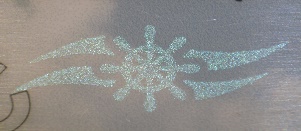
- Where it is
- Front, right-hand side.
- What it looks like
- A graphic element shaped like a steering wheel.
- How to check it
- Look at it in daylight from different angles (also turned by 90°).
The document you receive when you register your boat under the Polish flag: what it proves, how to recognise a genuine one and what each field means.
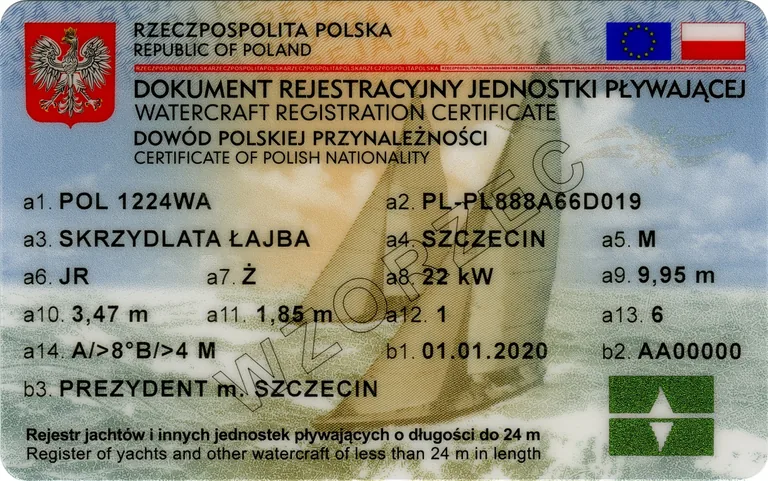
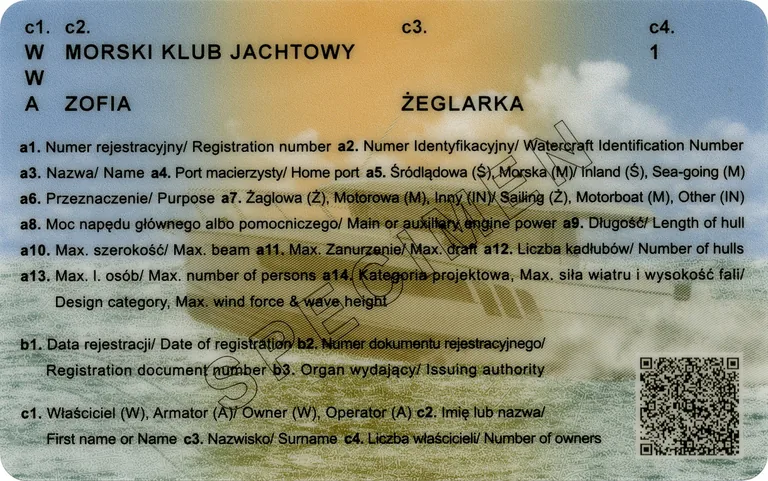
It certifies the Polish nationality of the boat and serves as proof of ownership. It covers yachts and other watercraft of less than 24 m in length.
It is issued by the registration authority (the district starosta or a sports association) under Article 4(1) of the Act of 12 April 2018 on the registration of yachts and other watercraft of less than 24 m in length.
The design is set by the Regulation of the Minister of Maritime Economy and Inland Navigation of 17 April 2020 (Journal of Laws, item 763).
It is a category one public document under the Act of 22 November 2018 on public documents, with several anti-counterfeiting features.
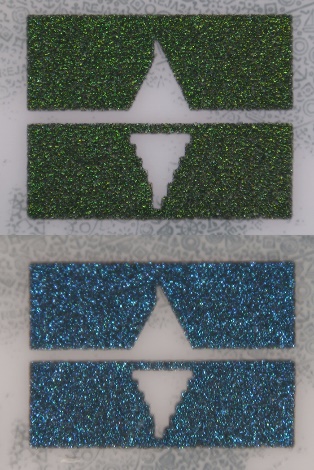
It is a public document with several anti-counterfeiting features. This is how to recognise each one:


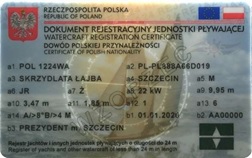
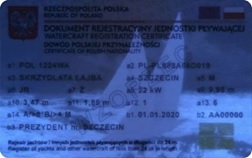
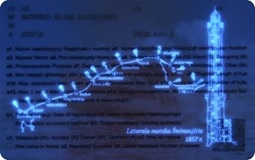






The fields on the front (a1 to b3) and on the back (c1 to c4), with the abbreviations used.
It is made up of POL (seagoing boat) or PL (inland boat), followed by a six-character combination of letters and digits.
It may be shorter if the boat was registered under the rules in force before the 2018 Act and the owner kept the number.
The number assigned by the manufacturer and marked on the hull under EU rules (Recreational Craft Directive, RCD): WIN and, for older boats, HIN or CIN.
If the boat has no number or it cannot be confirmed, the registry assigns an individual number (INI) that never changes and is not marked on the hull.
The name given by the owner. Seagoing yachts must have a name; inland ones do not, in which case the field shows three dashes.
It can have up to 33 characters, using letters of the Polish alphabet and Arabic or Roman numerals; it cannot resemble words used by emergency services or be vulgar or offensive. Names can be repeated.
For a seagoing yacht, one of the Polish sea ports. If it only sails on inland waters, any town in Poland.
If the owner declares that the boat will sail on both inland and sea waters, it is registered as seagoing.
What the boat is used for:
How the boat is propelled:
For a motorboat, the power of the main propulsion in kW. For a sailing boat with an auxiliary engine, «PNM» appears.
If a sailing boat replaces its engine with a different one, the document does not need to be replaced: the engine details stay in the REJA24 register (useful, for example, to identify stolen equipment).
In metres.
In metres.
In metres.
1 for a monohull, 2 for a catamaran, and so on.
It is set according to the stability of the boat. Without a CE declaration of conformity or other documentation stating it, the field shows three dashes.
The design category under the Recreational Craft Directive (2013/53/EU): A, B, C or D, each with the wind and wave height the boat was built for (table below). Without a category, the field shows three dashes.
| Category | Wind force (Beaufort) | Significant wave height |
|---|---|---|
| A | Over 8 (excluding abnormal conditions such as storms, hurricanes or tornadoes) | Over 4 m |
| B | Up to 8 | Up to 4 m |
| C | Up to 6 | Up to 2 m |
| D | Up to 4 | Up to 0.3 m, with occasional waves of up to 0.5 m |
The day the boat was registered.
The serial number of this document.
The body that registered the boat.
W stands for the owner or co-owner; A, for the operator.
The details of the owner, co-owner or operator.
The document shows the details of up to two co-owners. If there are more, their details stay in the REJA24 register and this field shows how many there are.
Source: official article on the Portal Publiczny REJA24 (Urząd Morski w Szczecinie).
Our team of Polish flag registration experts is ready to help you with your procedure.